Data-center electricity demand will double by 2030. It's been consuming more water, increasing our energy bills and its growing emissions are making the climate hotter and thus more costly. You can't improve what you don't measure. We're focused on ways to measure, improve and remediate impact towards making AI sustainable for the Earth, Everyone, Everywhere, Efficiently.
AI for Ecology is a 501(c)(3) nonprofit shepherding the Age of AI into sustainable ecosystems that benefit the Earth, Everyone, Everywhere — with Efficient use of energy and resources.
Global data-center electricity demand is on track to roughly double this decade — from ~415 TWh in 2024 to ~945 TWh by 2030 — as AI build-out accelerates.
Source: IEA, Energy and AI (2026)Nearly 60% of the electricity powering data centers today still comes from fossil sources — natural gas, coal, and oil.
Source: IEA / Carbon Brief (2025–26)The ten warmest years ever recorded have all occurred in the past decade, with 2024 the hottest year in 175 years of global records.
Source: NOAA National Centers for Environmental InformationU.S. residential electricity prices have risen 42% over the last five years — climbing as much as 94% in data-center-heavy regions like Washington, D.C.
Source: U.S. EIA, via PolitiFact (2026)AI-focused data centers' electricity use jumped 50% in 2025 alone — over 16 times faster than overall global electricity demand growth.
Source: IEA, Key Questions on Energy and AI (2026)Groundwater levels are falling in 71% of the world's monitored aquifers, with the pace of decline accelerating in nearly a third of them over the last four decades.
Source: Nature, global groundwater study (2024)"A choice, not physics" — leading scientists argue today's energy-hungry mega data centers reflect a competitive business strategy, not a technical requirement. AI can be built dramatically more efficiently. (Source: Nature commentary, Aug. 2026)
We're a collective of tech and sustainability professionals with hundreds of years of aggregate experience at the top tech companies and sustainable organizations. We shepherd the Age of AI toward ecosystems that benefit the Earth, Everyone, and Everywhere — with Efficient use of energy and resources.
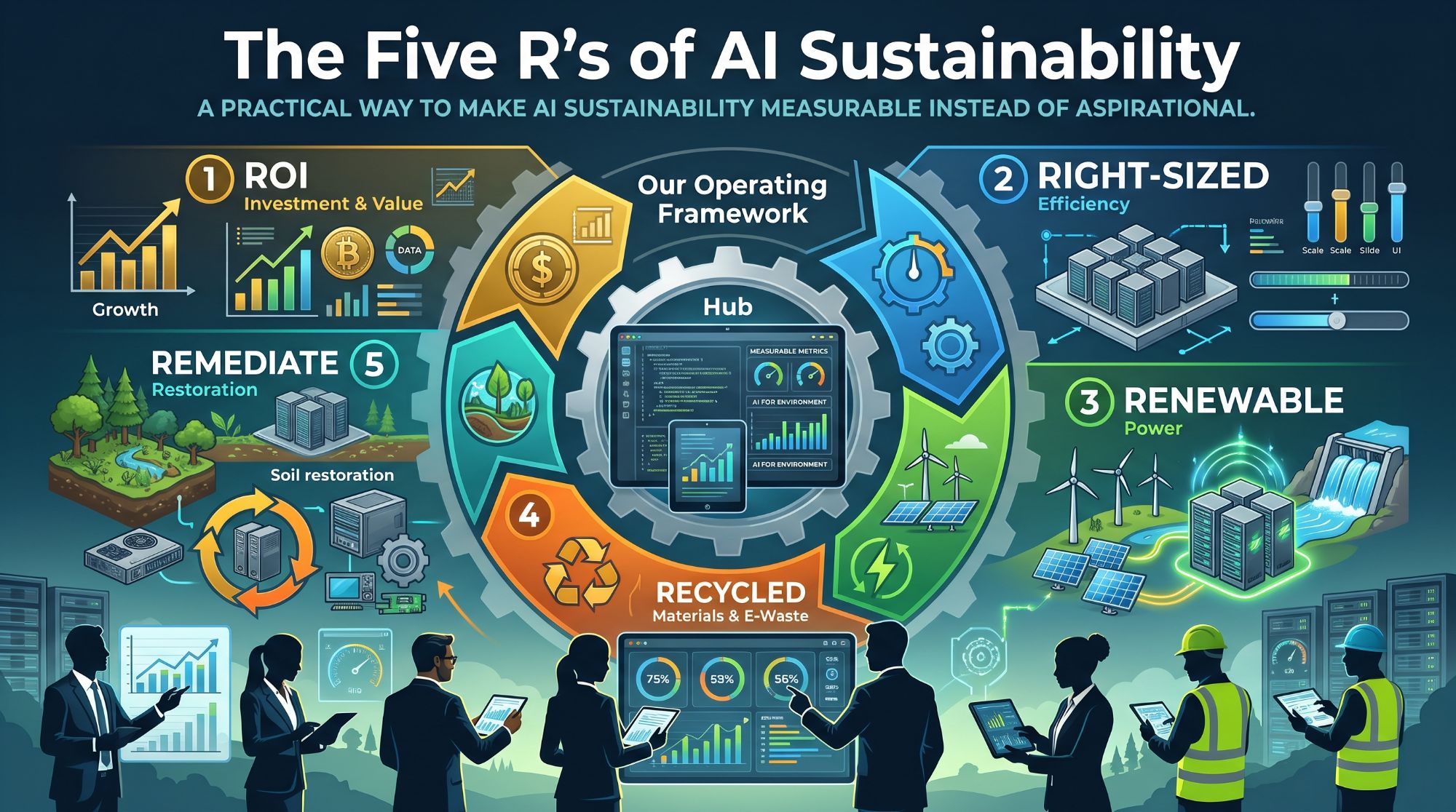
Our operating framework is the Five R's: ROI, Right-Sized, Renewable, Recycled, and Remediate — a practical way to make AI sustainability measurable instead of aspirational.
See the Five R's framework →Part of our Year 1 build: a community tool that estimates the cost, energy, water, carbon and heat behind AI queries, using the same method as the Stardust browser extension — and a step toward the tokens-to-carbon-output benchmark methodology we're publishing as part of our Benchmark & Certification Framework v1 (in development).
The free, open-source Stardust browser extension shows the same estimates as you chat on ChatGPT, Claude and Gemini. It's coming soon to the Chrome Web Store and Microsoft Edge Add-ons. Until then, download it from GitHub, unzip it, and add it with Load unpacked on your browser's extensions page (with Developer mode on).
Uses the same draft methodology (v0.2) as the Stardust browser extension. Energy per token by model size (small, mid, frontier), anchored to ~0.3 Wh for a typical frontier-model reply — Oviedo et al., Joule (2026), and Epoch AI (2025). Unlisted models use the frontier figures and are marked Estimated. Prices are list prices per token, September 2026. Grid carbon: U.S. EIA (2023) and Ember (2024 world average); France and Sweden are approximate 2023 mixes. Water: 1.8 L/kWh on-site cooling (LBNL, 2016) plus 3.14 L/kWh for power generation (Li et al., 2023). Heat: essentially all electricity used by servers becomes heat. Indicator code = impact grade (CO₂e per 1,000 tokens, A best to F) + cost tier (per query, 1 lowest to 5, X unknown) + size (tokens per query, XS to XL). Energy, grid and grade figures are draft placeholders pending review, published openly on GitHub. Forest equivalent: ~1.5 Mg C/ha/yr (≈0.55 kg CO₂ per m² per year) for 20–100-year-old Pacific Northwest conifer stands, from Fig. 5 of Gray, Whittier & Harmon, Ecosphere 7(1):e01224 (2016); excludes soil carbon and varies widely by site. Each icon ≈ 0.1 m². Chat apps resend the whole conversation with each message, so input grows as a chat goes on; reasoning models also use hidden thinking tokens.
The urgent problem: AI's electricity demand is growing exponentially, yet no standard, shared way exists to measure what real AI workloads consume. Benchmarks measure peak hardware speed, not the energy real requests use on a real grid at a real time, and every provider reports differently, so claims can't be compared or verified.
Observability and Actions to See what AI really costs — in dollars and impact, Connected to sustainability services for ROI – Return on Investment + Impact
Browser extension & SDKs on GitHub ↗ · Open source (Apache-2.0) · The full plan → · See the architecture diagram →
Stardust is the codename for an open, end-to-end AI sustainability operating system. It makes the energy, cooling, water and emissions of AI observable everywhere AI runs, from web browsers to AI applications to infrastructure, then connects that measurement to action. Its browser extension and SDKs are available today, free and open source. It has four parts:
One open schema for per-request AI energy, cooling, carbon and water.
Published as RFC 0001, built on OpenTelemetry and aligned with ISO/IEC 21031. Collected by browser extensions, application plugins and infrastructure agents, and covering time-of-use, lifecycle emissions (operational, facility, training, embodied) and confidence tiers.
In development: energy per token and useful output per kWh, to be measured in the open.
Tools and a continuous pipeline that will compare models, serving frameworks and hardware and publish all methods and raw results: the evidence base for AIforE's planned independent certification program.
Planned: right-sizing AI to use only what's needed.
Will track and recommend state-of-the-art reference architectures, including an open-source reference efficiency router that picks the right-sized models and architectures for the quality and service levels needed, for maximum ROI and reduced negative impact. Savings and quality trade-offs will be fully measured and observable.
From measured impact to verified action.
Links each organization's measured emissions, water and energy use to verified services that sequester carbon, recycle water, supply zero-carbon energy and more, including nature-based solutions (afforestation and reforestation, habitat restoration, ecosystem improvement) and technological carbon removal, through the AIforE carbon marketplace.